Adapted from a 2016 Buxton Museum and Art Gallery feature by Ben Jones, with additions and later updates by Explore Buxton.
It is natural for people to affectionately remember places that were once part of their daily lives. A town the size and age of Buxton has seen many changes. Businesses have changed hands countless times and shop fronts have transformed with the fashions of the age. These seven buildings are just a selection of notable structures that have vanished from the landscape altogether.

Cavendish Girls’ School, Corbar Road
From 1973, Buxton had separate boys’ and girls’ comprehensive schools. Cavendish was the upper site for Buxton Girls’ School, while Buxton College was the boys’ upper site. The schools were brought together at the coeducational Buxton Community School from 1990; the former girls’ school was later demolished and replaced by housing. An earlier version of this feature recalled an English A-level student crossing the playground to attend lessons here. The Derbyshire Record Office confirms that the building opened as Wye House Asylum in 1861 and became Cavendish School in 1912.

Buxton Youth Hostel, Harpur Hill Road
For many years, Buxton had a youth hostel at the bottom of Harpur Hill Road. The Youth Hostels Association archive records that Sherbrook Lodge closed on 28 February 2003 and was subsequently sold. The building was later demolished.

Empire Hotel, Park Road
The Empire Hotel was a large hotel in the heart of Buxton. During the First World War it became a Canadian discharge depot for soldiers returning home. The building was demolished in 1964 after years of dereliction.

High Peak College, Harpur Hill
A page from a college brochure.
High Peak College moved to former RAF buildings at Harpur Hill in the 1960s. Ofsted’s February 2011 report still described University of Derby courses at Harpur Hill. A later council report says the former college buildings within the housing development site were demolished in 2011. In his 2016 feature, Ben Jones recalled the college’s remote setting, student accommodation and varied courses.
 The Picture House, Spring Gardens
The Picture House at the end of Spring Gardens was later known as the Spa Cinema. A cinema history records that its cinema and bingo club closed in 1986. In the original museum feature, Ben Jones recalled queueing here to see Ghostbusters as a teenager.

Market Hall, Market Place
The Market Hall burned down in 1885, and the Town Hall was built on its site and opened in 1889. This photograph shows people gathered among the ruins; the mount bears the name B.W. Bentley.

Milligans, Spring Gardens
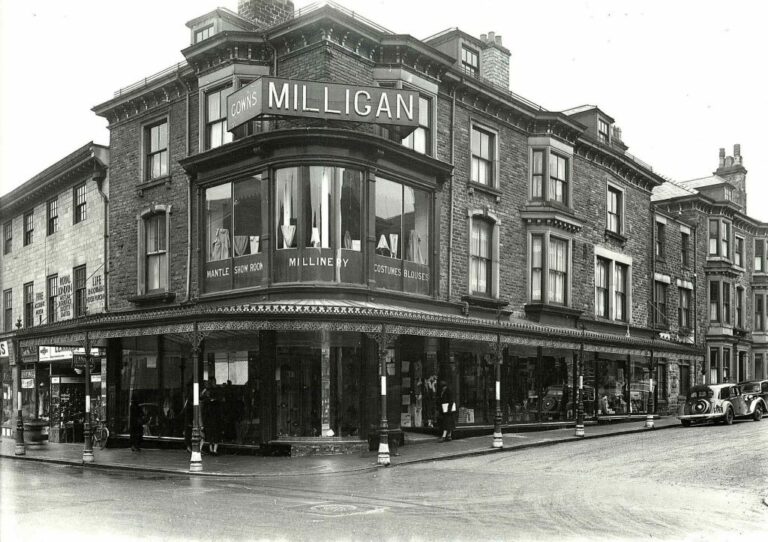
In his 2016 museum feature, Ben Jones described Milligans as one of Buxton’s most fondly remembered shops and said it was founded in 1846. The original building was demolished in the 1970s; Argos now occupies the site. Jones recalled accounts of a floorwalker and cash being sent to the accounts department. A cash-carrier history describes a wire system at the shop. The original feature dates this photograph to around 1940. A local history account describes colonnades along the north side of Spring Gardens in 1910.
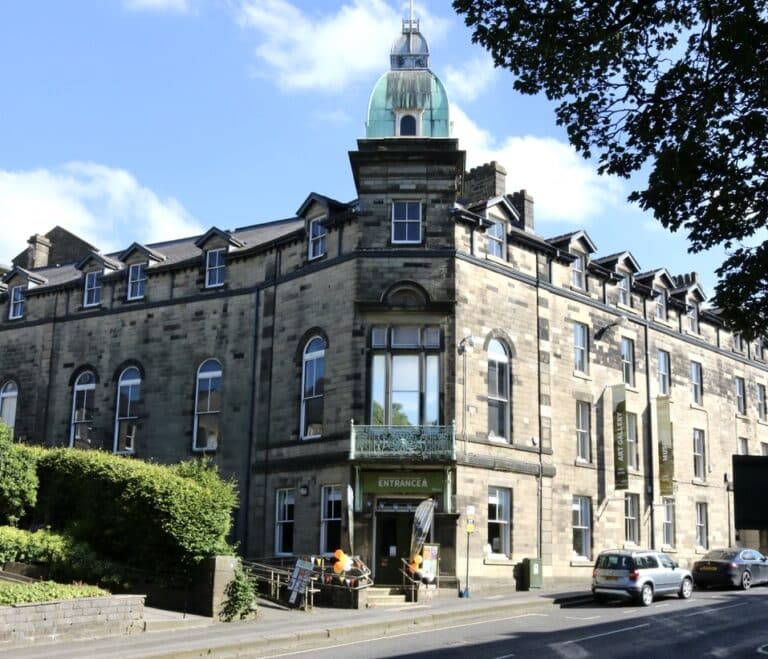
In 2016, Ben Jones was Visitor Services Officer for the Collections in the Landscape project at Buxton Museum and Art Gallery. The museum has since moved to a temporary home next to Buxton Library.
The original museum feature credits its black-and-white photographs to the J.R. Board collection and says Buxton Museum cares for part of it. For image reproduction, contact buxton.museum@derbyshire.gov.uk. More photographs can be explored at Picture the Past.
Advertisement