Poole’s Cavern is a limestone show cave with remarkable stalactites and stalagmites. The cave, Buxton Country Park and Grin Low are home to a variety of wildlife and fascinating history.
1) The cavern’s formations include the Flitch of Bacon, a stalactite around two metres long, and formations historically known by names such as The Font.
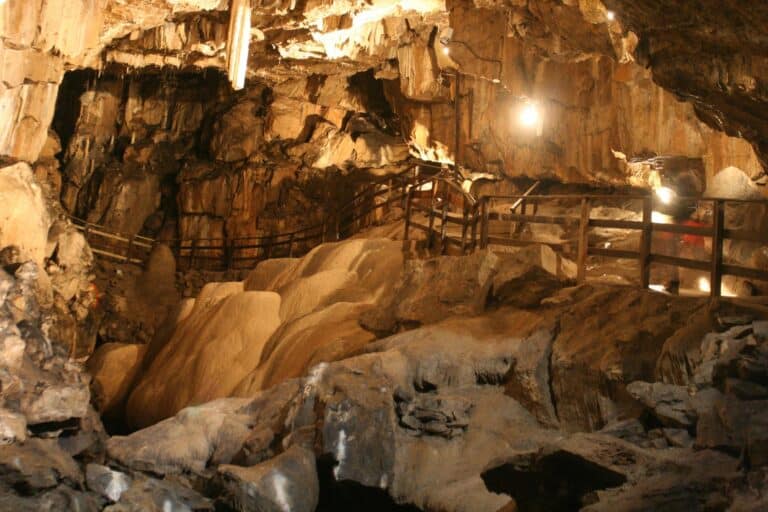
The image below shows stalagmites in the cave.

2) Some of the cavern’s unusual stalagmites grow particularly quickly. Researchers have measured growth of up to one centimetre a year in lime-rich water influenced by historic lime burning above the cave.

3) Some Poole’s Cavern stalagmites contain annual growth layers. Researchers have studied these layers for evidence of past rainfall.

4) The unusually fast-growing formations influenced by lime waste are less than 250 years old, according to the British Cave Science Centre. The ages of the cavern’s other formations are still being investigated. Read the researchers’ explanation.

5) Surveys have recorded Natterer’s and Daubenton’s bats roosting in the cavern, and whiskered bats at its entrance.

6) A woodland walk of around 20–40 minutes leads from Poole’s Cavern to Solomon’s Temple on the summit of Grin Low.

7) Poole’s Cavern and Grin Low Wood form a Site of Special Scientific Interest, recognised for the cave’s geology and the habitats above ground.

8) Water sinking into the ground on Stanley Moor feeds underground drainage in the Buxton area. Dye tests have shown connections with Poole’s Cavern and springs in the Wye valley.

9) Archaeologists have found animal bones, prehistoric material and Roman objects at Poole’s Cavern. The finds offer clues to the site’s long history, though their interpretation is not always certain.

10) Solomon’s Temple stands on a Bronze Age burial mound. An excavation in 1894, before the present tower was built, found burials and grave goods, as well as later Romano-British pottery. See the Derbyshire Historic Environment Record.

11) According to local legend, an outlaw named Poole used the cave as a hideout and robbed travellers.

12) In 1859, the cave’s candle lighting was replaced by gas lamps supplied from the town. Some old gas pipes can still be seen in the cavern.

13) Poole’s Cavern was one of the seven Wonders of the Peak described in Thomas Hobbes’s Latin poem De Mirabilibus Pecci, first printed around 1636.

For visitor information and opening times, go to buxtoncivicassociation.org.uk/pooles-cavern or visit their Facebook page at facebook.com/poolescavern
Advertisement
Advertisement